Reading the sky in Orush
Salt, observation and the discipline of not knowing
The towers of Orun stand above the salt plateau. The observers record the heavens, but the record is not a complete answer.
← All world notes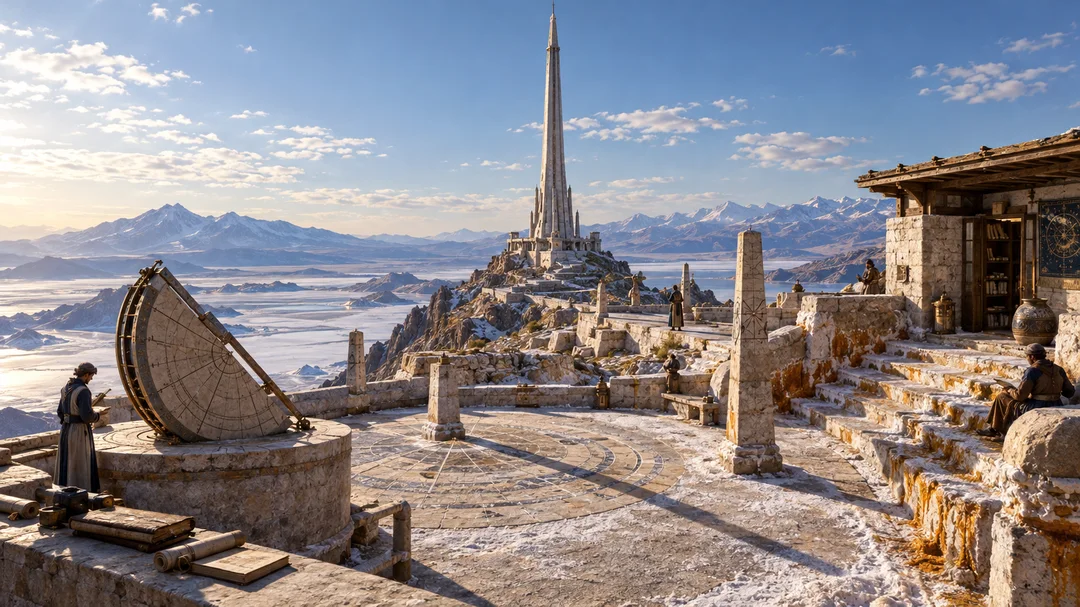
A country of long distances
Salt, pale rock and open sky define the Orush plateau. A traveler needs marked routes, shelter and attention to water. The vast distances become visible in small things: a cairn, a stone measurement or the narrow shadow of a sheltered terrace.
The towers of Orun belong to this environment. They stand not merely to impress an approaching caravan but because seeing far and measuring carefully have meaning here.
The work behind a symbol
An observatory does not require invented glowing machinery to feel mysterious. A worn threshold, repeated marks in stone and a record kept over years can make the work of watching the sky tangible.
The difference between an observation and its interpretation is a powerful story in itself. MYRHA preserves unanswered questions. A website devoted to the world should keep those questions open rather than turn every trace into a definitive theory about the Wound.
A route is not a revelation
Sahren-Deh lies east of the northern ridge of Orun. Such a geographical relationship can be described without asserting a journey time or making up a particular road. A map can point toward a place; it cannot prove what happened there.
Orush invites a patient kind of discovery: follow the measured stones, learn why the sky matters to those who watch it, and accept the limits of what is publicly known.